General categories of
light and shadow determine what we respond to when observing value structure.
These categories are highlight, light, shadow, core of shadow,
reflected
light, and cast shadow.
These six categories are
then divided into two distinct areas known as direct and indirect light.
Direct light includes highlight and light which refer to the surface of an
object that is in the direct path of a light source and is the brightest of
all.
Indirect light would be shadow, core (of) shadow, reflected
light, and cast shadow. All of what is not in the path of the direct light
source.
A
General-To-Specific Approach to Building Value Structure
Utilizing this approach
can keep your drawing working together and allows for adjustment when needed.
By working together your drawing needs to follow steps and each will be
completed before moving to the next.
For example: if you want
to build a house you need to make sure to complete every step before moving on
to a new one or the house will be no good. Then after finishing the general
steps, you can then add detail and finishing work.
Using
Value to Establish an Effect or a Mood
There are many different
ways to use value structure in drawing to promote different moods or
effects.
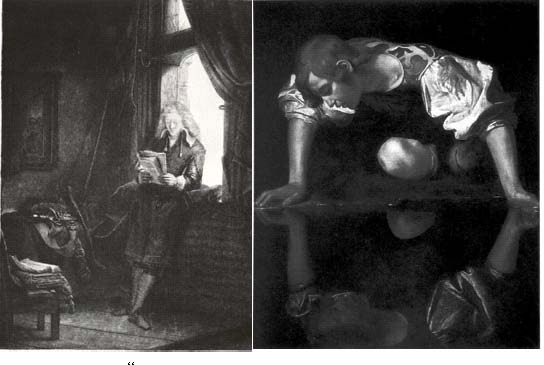
Chiaroscuro - Originated in the Renaissance and rooted in
Italian meaning light and shade.
Tenebrism - Also originated in the Renaissance and rooted
in Italian meaning dark and gloomy.
Plastic value - Value used to describe the illusion of volume
and space or plastic form, sharing characteristics with Chiaroscuro.
Low-key value - Predominately dark values often used to create
an effect of gloom, mystery, drama, etc..
Middle-key value - Mid-range value used at the artists
discretion.
 High- key value - Light values used to create an effect such as
delicateness
Value is a significant component of texture such as
smooth, rough, animal fur, foam, cardboard, etc.. Texture is what materials we use and how we apply
them. A light source can also determine the texture of the work.
Different types of texture:
Actual - what can be felt with your fingers.
Simulated - cannot be touched but is suggested through the
artists value changes.
Uniform - is the overall texture in a drawing that comes
from the material surface it was drawn on.
Invented - this can be invented by using a variety of
hatching, crosshatching, etc.
Frottage - this is not a texture but a technique that
relies on texture for its results. This is the rubbing or transfer
method.
FOUR
THINGS TO LOOK FOR WHEN IDENTIFYING VALUE STRUCTURE ON A FORM
The Light Source
It is important to
identify the light source and an easy way is to take a clip-on light and
illuminate the subject being drawn, then move the light slowly in
different positions.
The Shape of Areas of
Shadow and Light
With this observing the
shape of areas of light helps to define the adjacent areas of the shadow.
Variations of Value
Within Larger Shapes of Value
Once you have identified
the largest, simplest areas of shadow, you being to note the variations found
within the larger shape. To make sense of all of this, you need to be aware of
the six divisions of light.
Edge Quality of Shapes
of Value
With edge quality you
have to make sure everything stays the same throughout the shape, there is
good transitions, and that everything remains constant.
Various
Methods for Applying Value
Continuous tone: is used to create a smooth structure that
flows from one value to the next.
Contour hatching: the lines or strokes follow the curvature or
planar directions of the object.
Cross-hatching: layers of parallel hatching that change
direction while overlapping and building value.
Stippling: this is often applied in pen and ink or marker
of dots of value laid down at a time.
 Mark making: this is the application of marks that vary in
weight, value, texture, length, and direction.
Subtracted drawing: this is done with any type of charcoal and a
piece of paper. The material is rubbed into the paper with a cotton
cloth.
An
Alternative Subtracted Process: this is done by taking a heavier piece of paper,
taping the sides down, and instead of using a cotton cloth, use a stiff brush
to create lines and go about it randomly.
Toned Paper: although it is a lot like subtracted drawing, this is
opposite in the sense that artists start out with lighter values instead of
darker at first and this can be done by using white charcoal or white chalk.
However, it is very important that the white and black medias do not mix
together.


 High- key value - Light values used to create an effect such as
delicateness

 Mark making: this is the application of marks that vary in
weight, value, texture, length, and direction.


